
The binational agreement enables a new international tender to secure the maintenance of the Martín García Channel, a strategic waterway for navigation, ports, and foreign trade in the Río de la Plata.
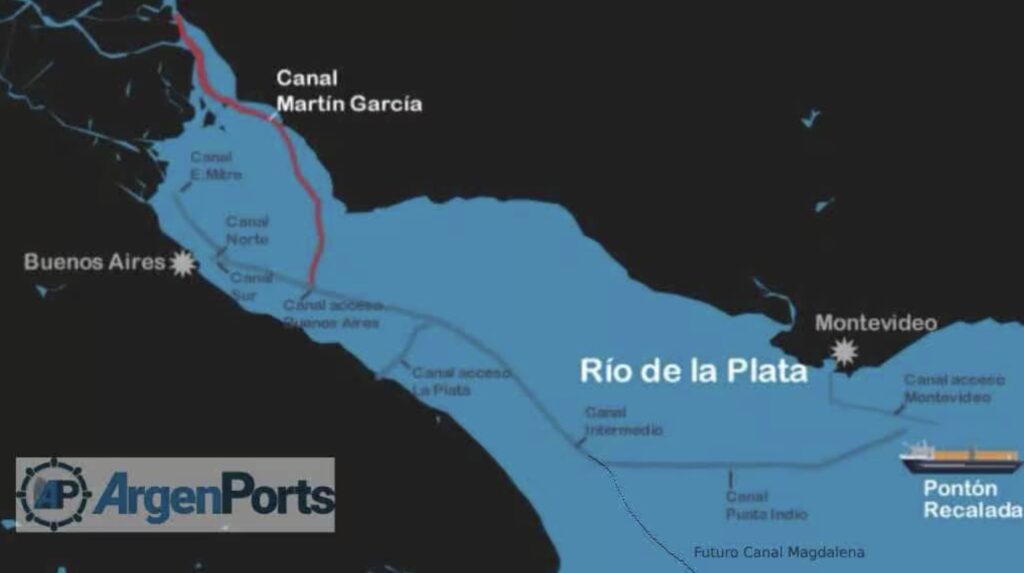
After a prolonged period of political and technical tensions, Argentina and Uruguay have managed to unblock the dredging of the Martín García Channel, one of the most important arteries of the Río de la Plata navigation system.
The understanding was reached within the framework of the Administrative Commission of the Río de la Plata (CARP).
This binational body, which is responsible for managing the channel, allows progress toward a new maintenance scheme after months of operational uncertainty.
The Martín García Channel connects the port systems of Argentina’s and Uruguay’s river littoral with the outlet to the Atlantic Ocean.
It is used continuously by bulk carriers, tankers, and general cargo vessels.
Throughout much of 2025 and early 2026, differences between the two countries focused on technical issues. These were related to channel depth, the scope of the works, dredging financing, and the contractual framework.
The lack of sustained maintenance began to raise concerns among shipowners, maritime agencies, and port operators due to the direct impact that loss of draft has on cargo capacity and logistics costs.
Dredging of the Martín García Channel and International Tender
In this context, CARP decided to move forward with a new international tender aimed at guaranteeing dredging of the Martín García Channel over the medium and long term.
The decision was adopted during a session held on January 21 and subsequently published in the Official Gazette, formally authorizing the call for bids.
The project includes works along a stretch of approximately 106 kilometers.
The objective is to maintain design depths of 34 feet in soft-bottom sections and up to 38 feet in hard-bottom areas.
According to the Uruguayan outlet El Observador, the agreement made it possible to unlock the accumulated conflict.
In this regard, a transition scheme was agreed upon to ensure continuity of works until final award of the contract.
Interested companies may submit bids until March 16. The tender documents cost USD 50,000, and a bid bond of USD 1 million is required.
Contract Expiration and the Transition Phase
One of the most sensitive points was linked to the expiration of the current contract, scheduled for February 1, which made it necessary to negotiate transitional mechanisms to avoid interruption of the service.
The consortium currently in charge of the works is made up of Boskalis and Dredging International, operating under the name CBDI, with which there was also an estimated outstanding debt of around USD 5 million.
This issue became one of the main sources of tension between Argentina and Uruguay and ended up delaying any operational decisions for months.
Impact on Ports and Foreign Trade
The Martín García Channel plays a strategic role within the Río de la Plata port system, as it concentrates a large share of river traffic connecting littoral ports with the ocean.
Its operability is key for Argentine terminals such as Buenos Aires and Dock Sud, as well as for the Uruguayan ports of Nueva Palmira and Montevideo.
The channel’s effective depth directly affects transported tonnage, voyage efficiency, and the competitiveness of foreign trade.
A Signal of Logistical Predictability
The agreement is seen by the sector as a signal of predictability after a prolonged period of uncertainty.
The normalization of dredging will improve operational planning, reduce risks, and strengthen regional logistics integration.
With the tender underway, Argentina and Uruguay aim to leave behind a stage of conflict and move toward more coordinated management of a strategic waterway for Río de la Plata trade.